Roof Replacement
Re-roofing in tile or Colorbond for the ageing brick-and-tile estates around Campbelltown and the newer builds at Oran Park and Gregory Hills.
Learn more →Leak tracing, ridge re-pointing, valley and flashing repairs on tile and metal roofs across Campbelltown, Camden and the Macarthur suburbs.
Re-roofing in tile or Colorbond for the ageing brick-and-tile estates around Campbelltown and the newer builds at Oran Park and Gregory Hills.
Learn more →Colorbond re-roofing and new installs across Macarthur, including full tile-to-metal conversions on 1970s and 80s homes.
Learn more →A cheaper alternative to replacement for Macarthur tile roofs: pressure clean, rebed and repoint the ridges, then recoat.
Learn more →Gutter and downpipe replacement sized for Macarthur storm runoff, plus leaf guard where gums overhang the roofline.
Learn more →Same-day make-safe after a Macarthur hailstorm, with photographed damage reports you can hand straight to your insurer.
Learn more →Written roof reports across Macarthur for buyers, sellers, landlords and insurance claims.
Learn more →Most people do not call about their roof. They call about a ceiling.
The stain over the hallway, the flaking cornice paint, the musty smell in the linen cupboard, the drip that only appears when the rain comes from the south-west. Those are roof symptoms showing up two metres below the fault, and the fault is almost never where the stain is.
Roof repairs across Campbelltown, Camden and the Macarthur suburbs start with tracing water back uphill to where it actually got in. Call (02) 4601 5100 for a free inspection.
Before anyone climbs a ladder, stand on the far side of the road and look along the ridge line and the hips. From a footpath in Leumeah, Raby or Ambarvale you can usually pick the three big ones:
Inside, go into the roof space with a torch on a dry day and look at the underside of the battens and the top of the ceiling joists. Dark tide marks and white mineral staining tell you where water has been running, and that is far more useful than where the ceiling stain appeared.
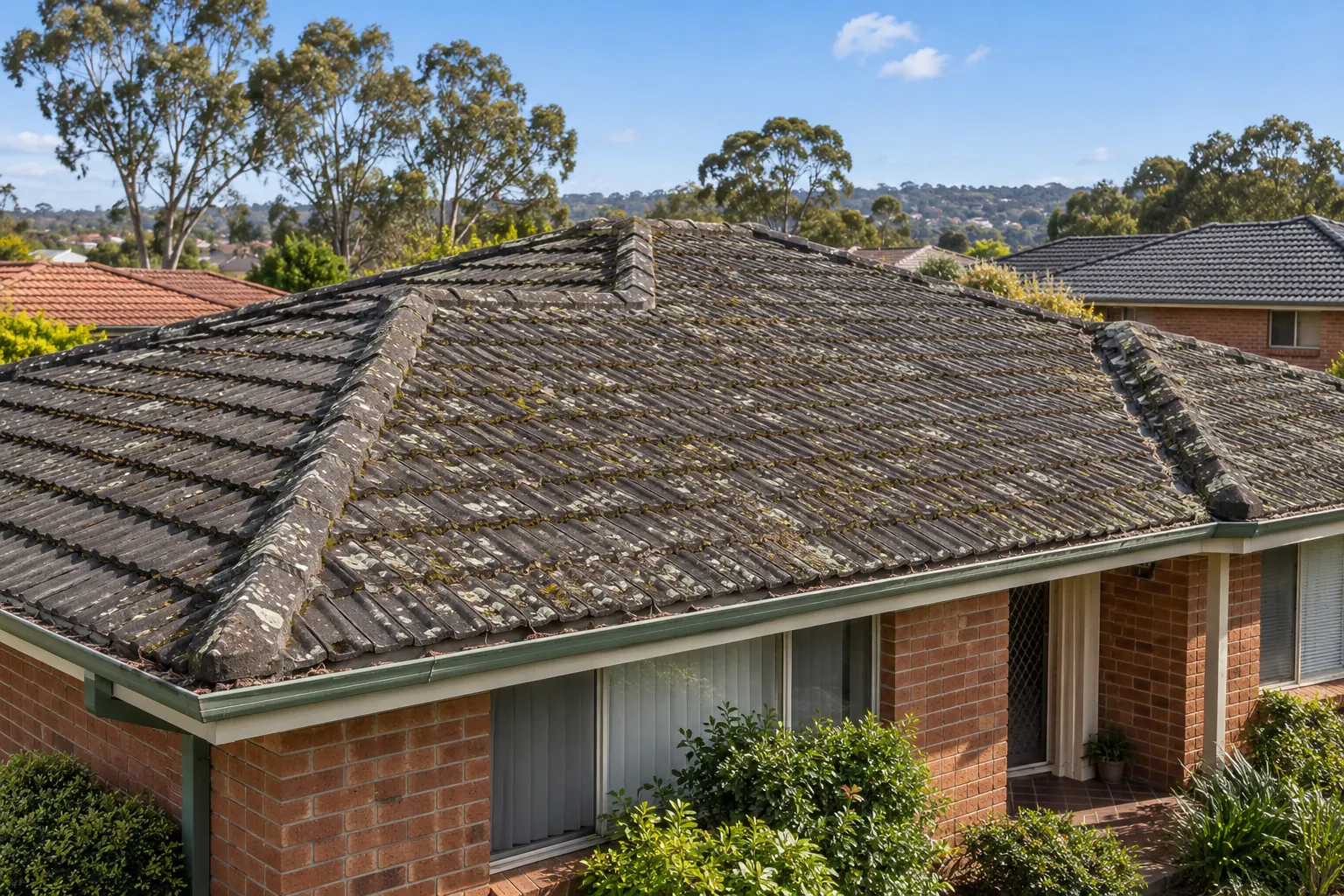
The number one job in this district, by a long way. Concrete tile roofs through Minto, Ingleburn, Macquarie Fields, Woodbine, Eagle Vale and Rosemeadow were pointed with rigid cement mortar. Four decades of inland heat cycling — hot days, cool nights, repeat — crazes that mortar until it falls out in crumbs.
Once the pointing is open, two things happen. Water tracks under the caps into the batten cavity, and the caps themselves lose their grip and start moving in wind. Repointing with a flexible pointing compound over properly re-bedded caps solves both, and it is a contained job while the tiles are still good.
Valleys are where two roof planes meet and dump their combined water into a single metal gutter. In the older estates those valleys are galvanised steel, and they have a shorter service life than the tiles above them. Add the leaf load from the big established gums and callistemons planted through the 1980s streets, and you get a dam that keeps the metal permanently wet. Valleys rust from the bottom of the trough upward and the leak lands in the middle of a room.
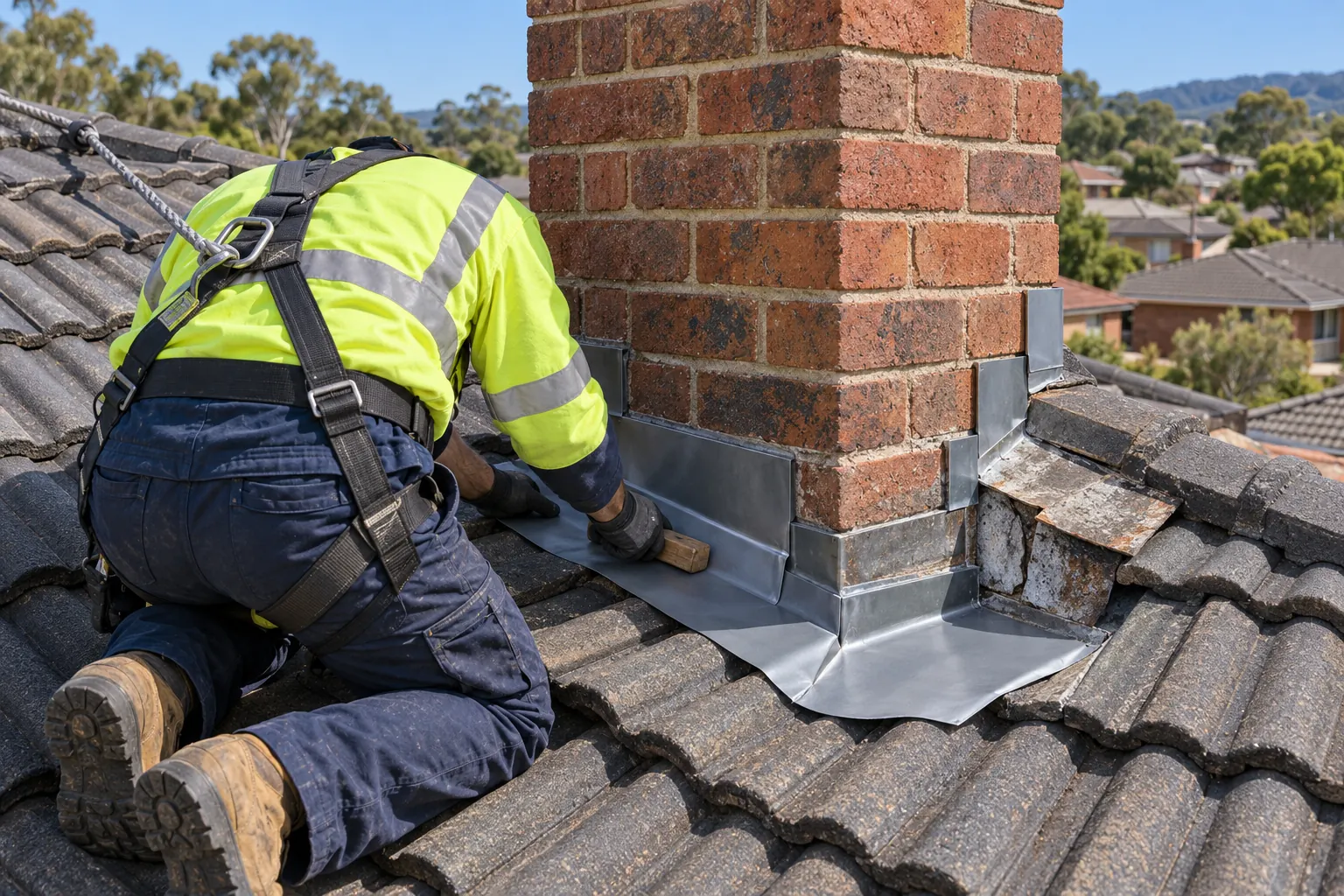
Anywhere the roof is interrupted, water looks for a way in: chimneys, skylights, vent pipes, aerial mounts, whirlybirds, solar feet, and the apron where a lower roof meets a wall. On the newer Oran Park and Gregory Hills builds, the apron and parapet flashings are the usual culprits because they rely on sealant that UV eventually kills.
Hail cracks tiles. Antenna installers and air-conditioning technicians break them. Tree limbs break them. A single cracked tile high on a roof plane can feed water across several metres of batten before it finds a ceiling. Replacing tiles is simple work; finding the right one on a 1980s roof with a discontinued profile is the part that takes experience.
Not strictly a roof fault, but it leaks like one. When a gutter fills, water backs up over the gutter lip, under the first row of tiles and into the eaves. If your fascia timber is soft or the ceiling stain is along an external wall, start with the gutter. We cover that under gutter repair and replacement.
This is the part that surprises homeowners. Water entering at a ridge in the middle of the roof will run along the top of a batten, cross to a truss, follow the truss down, and emerge at the low point — which might be a light fitting in a different room entirely.
That is why we do not patch at the stain. We trace the path, confirm it, and repair the entry point. Guessing turns one repair into three.
Make-safe work can usually happen on the spot if the roof is open and rain is coming. Everything else gets quoted, and you decide in your own time.
Honest version: repairs are the right answer until they are not.
We will tell you which category your roof is in, including when the answer is the cheap one.
No dollar figures over the phone, because the variables are real: how many metres of ridge and hip need re-bedding, how many valleys, single or double storey, roof pitch, access for ladders and a truck on the block, whether tiles can be matched, and how much timber has gone soft. The quote follows the inspection, in writing, and it is free.
Call (02) 4601 5100, or send the details through the quote form and describe what you have noticed — the room, the weather it happens in, and roughly how long it has been going on. That alone tells us a lot before anyone arrives.
A dry stain means water has already been in there at least once, and it will be back with the next decent rain. The useful thing about catching it dry is that the plasterboard and the roof timbers above it are probably still sound, which keeps the repair to the roof instead of the ceiling as well. Get it traced now rather than after it starts dripping.
That is the signature of an unsarked tile roof, which describes a lot of Campbelltown housing built before the 1990s. In ordinary rain the tiles shed water fine. In a southerly, rain is driven uphill under the tile laps and sideways past ridge caps, and with no sarking membrane underneath there is nothing to catch it. The fix is usually pointing, flashings and localised sarking at the problem area.
Individual tiles are replaceable, and on a sound roof that is exactly what should happen. The complication in older Macarthur estates is matching profile and colour on a discontinued tile. We keep repairs to the smallest sensible footprint, but if a roof is breaking tiles every time someone walks on it, replacing a handful is money spent twice.
Yes. On the newer estates the metal repairs we do most are failed screw washers, flashings at parapets and box gutters, dented or split sheets after hail, and leaks around skylights, whirlybirds and solar mounts. Metal needs a different approach to tile, particularly around sealing and expansion, and it is worth getting right the first time.
You get told before anything is done, and you get it in writing. The quote separates what is urgent from what can reasonably wait a season, so you can stage the work. There is no obligation after an inspection, and we would rather you understood the roof than said yes quickly.
Tell us what you need and we'll get straight back to you. Prefer to talk? Call (02) 4601 5100 and speak to someone local.
Call (02) 4601 5100